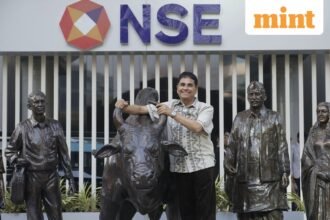
Addressing the long-running debate between “Do It Yourself” (DIY) investing and professional advice, Mohan stripped away industry jargon to highlight a striking shift underway. India, he said, is in the middle of a historic transition from savers to investors. “In the last five years, the ratio of mutual fund assets to bank deposits has almost doubled,” Mohan noted.
At the same time, nearly half of new mutual fund inflows now come through direct channels, raising a critical question: are investors navigating markets with a plan, or simply following the loudest voices on social media?
Influencer epidemic
Mohan pointed to what he described as a modern paradox – the rise of financial influencers. While 80% of followers admit to being influenced by these online voices, only 2% are registered with the Securities and Exchange Board of India (Sebi), he said. The risk, he argued, goes beyond poor advice; it undermines the single most important ingredient for long-term success.
“In the markets, the answer to success is discipline. Discipline trumps everything else,” Mohan emphasized.
If discipline is so critical, why is it so rare? The answer, he argued, lies in human psychology.
The real enemy: investor psychology
Drawing on behavioural science, Mohan outlined the cognitive traps that derail even informed investors.
He illustrated framing bias through a simple “Yogurt Test”: describing a product as 95% fat-free feels more appealing than calling it 5% fat, even though both statements mean the same thing. He also cited the Solomon Asch experiment, in which 70% of participants ignored clear visual evidence to conform to a group’s incorrect answer. “We are wired to think along with the crowd because, in a tribe, standing alone meant you wouldn’t live very long,” he said.
Using horse racing as a metaphor, Mohan explained overconfidence bias. As bettors receive more information, their confidence rises even though their probability of winning does not. “You think you’ve done a whole lot of research, so your bet increases,” he warned.
Easy walks vs Everest
Who, then, actually needs an advisor?
A trekking enthusiast, Mohan turned to the mountains for an analogy. A walk in a neighbourhood park, an “easy trek”, requires no guide. But as terrain becomes more complex, such as climbing Kalsubai, Maharashtra’s highest peak, uncertainty rises. And Everest, he noted, is another category entirely. “Have you ever heard of any Everest-er doing it without a Sherpa?” Mohan asked.
When stakes are high, he cited ₹25 lakh as the cost of a summit attempt, expertise becomes indispensable. Markets, he said, behave similarly. “In a market that oscillates between greed and fear, over-reaction and under-reaction, your chances of doing damage to yourself are very high.”
Planning in a cold state
Data supports this behavioural gap. Mohan cited a Morningstar research that showed that across fund categories – large-cap, mid-cap, small-cap and thematic – investors typically earn 2.5-5% less annually than the funds themselves.
“This happens because investors tend to act against their own interest,” he said. During sharp declines, alarming headlines trigger panic. Investors stop systematic investment plans (SIPs) or redeem near market bottoms, locking in losses, only to return when markets and NAVs have already recovered. “Panic reactions are like self-goals. We have a tendency to hit our own self-goals.”
His solution: plan decisions in what he called a “cold state,” when emotions are calm. Investors should write down in advance how they will respond if markets rise or fall by 10%. “Write it down, because when the market corrects, trust me, your mind will not be in the same place as when you wrote that statement.”
He also stressed annual asset-allocation reviews, something, he said, many DIY investors fail to execute. “An investment coach acts as a sounding board to make sure you have this conversation and use this tool appropriately.”
No shame in a coach
Mohan closed with a broader message: seeking guidance is a hallmark of high performance, not weakness. “The top athletes in this world, like Novak Djokovic, have coaches. There is no pride in suffering alone; it’s actually way too costly.”
An advisor’s value, he said, lies less in fund selection than in judgment and behavioral discipline. “We are all human beings. We all have our biases. It is important to have a coach who can help you identify and work on them.”
The stock market, Mohan’s message suggested, is not merely a contest of numbers but a test of temperament. Investors who recognize their own behavioural limits and treat investing less like a casual walk and more like a high-altitude climb stand a better chance of reaching the summit without sabotaging themselves along the way.